Thursday, June 2, 2011

Moving day

I bit the bullet and decided to make my own Wordpress blog over at futureskyline.com.

Edit:  Blogger rules.  Wordpress is great--in fact it's currently my favorite CMS.  Still, Blogger rules.

Wednesday, June 1, 2011

ProcessingJS on Chrome


Was experimenting with ProcessingJS today, which is pretty awesome.  Anyway, Firefox was handling the processing sketches just fine, but on Chrome I kept getting errors. 

Turns out a bug report had already solved this problem.  On Ubuntu you can just go to System/Preferences/Main Menu, find the Chrome browser icon, go to Properties and add this to the end of the "Command" field:

--allow-file-access-from-files

That was easy.

Wednesday, May 11, 2011

My Latest Leet Program

Just for fun today I did an update of an EnglishToLeetSpeak translator I had written a couple years ago.  I noticed that when I posted my update, my post count was almost ironic.  :-)

For a sample of how it works, look at this paragraph from my previous post:

Before:

Spent some time today installing a barebones (ie. no desktop) version of Ubuntu on an old Acer Aspire One netbook.  Feels weird to refer to it as old, as it was only a few years ago....


After:

S|>en† So]V[e †!]V[e †o])ay !nS†aLL!nG a (3aRe(3oneS (!e. no ])eS|<†o|>) veRS!on of µ(3µn†µ on an oL]) aceR aS|>!Re one ne†(3oo|<.  feeLS UUe!R]) †o RefeR †o !† aS oL]), aS !† UUaS onLy a feUU yeaRS aGo....

Here's the code: 

#!/usr/bin/env python
# -*- coding: utf-8 -*-

# leet.py
# an experiment in python to produce a good leet encoder
# that does not use a one-to-one mapping
# mFragin May 2011
# version 1.5 maps first and then substitutes, so
# each example is internally letter consistant

import random, string

myDefinitions = [["4","@","/-\\","∂","λ","a","A"],
["6","I3","ß","|:","(3","/3","b","B"],
["¢","(","©","c","C"],
["∂","])","[)","T)","cl","d","D"],
["€","£","ë","e","E"],
["]=","ph","|=","f","F"],
["6","(_+","9","(γ","(_-","cj","g","G"],
["/-/","]-[",")-(","|~|","]~[","}{","h","H"],
["!","|",":","i","I"],
["_|","_/","]","j","J"],
["|<","k","K"], ["1","|","|_","l","L"], ["|v|","]V[","(T)","|\\/|","/\\/\\","m","M"], ["|\\|","]\\[","~","n","N"], ["0","[]","¤","Ω","o","O"], ["|o","|>","p","P"],
["(_,)","0_","O,","q","Q"],
["12","®","|2","r","R"],
["5","$","§","s","S"],
["+","-|-","†","t","T"],
["|_|","L|","µ","u","U"],
["\\/","√","v","V"],
["vv","\\V/","\\X/","UU","w","W"],
["%","><","}{","x","X"], ["Ψ","¥","y","Y"], ["2","z","Z"]] myKeys = string.ascii_lowercase # Make a dictionary of the keys and values myDict =dict(zip(myKeys, myDefinitions)) # Get a string from user and make it lower case stringToConvert = raw_input("\nEnter a string: ").lower() leetString = "" variations = int(raw_input("\nHow many variations? ")) for i in range(variations): leetString = "" chosenLetters = {} for letter in stringToConvert: if letter in chosenLetters: leetString += chosenLetters[letter] elif letter in string.ascii_lowercase: choice = random.choice(myDict[letter]) leetString += choice chosenLetters[letter] = choice else: leetString += letter print leetString

Saturday, May 7, 2011

Ubuntu Command Line Only Installation

Spent some time today installing a barebones (ie. no desktop) version of Ubuntu on an old Acer Aspire One netbook.  Feels weird to refer to it as old, as it was only a few years ago that netbooks were hot as anything.  Of course then Microsoft felt the need to spread their OS virus onto all the Linux netbooks.  The rest is history--no one uses netbooks anymore.  So I guess Microsoft won, and lost. 

Pretty silly to imagine running Windows on a netbook....

Notes to self:
  1. I used Unetbootin and the Ubuntu Minimal Install iso image.
  2. Installed only the basic command line stuff
  3. Now to add CLISP and a few other things....

Thursday, April 28, 2011

Homebrew to the rescue--part two


Been having a terrible time lately with Text Wrangler in my Python class.  For some reason, Text Wrangler is causing a ton of problems handling whitespace correctly.  Of course we already Googled the heck out of the issue, set the expand tabs, etc....  The problem, however, is that TW is simply not that great if you've ever used Geany.

So now I at least have Geany on my MacBook.  Testing it for the lab.

Hard to blame students for being frustrated with a ton of "unexpected indent" errors.

Friday, April 22, 2011

Homebrew to the rescue!


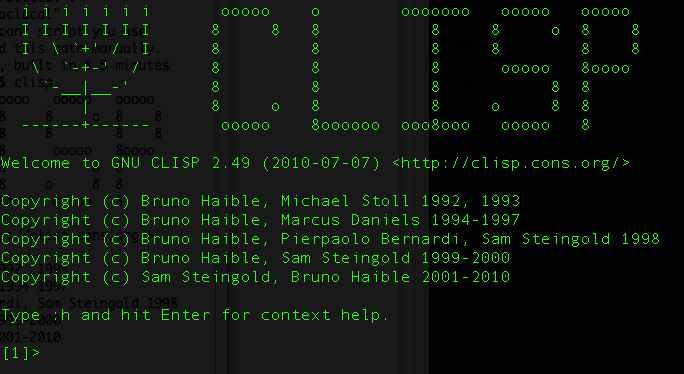
I recently purchased a book on Lisp programming that looks quite good.  Getting CLISP installed on Mac OSX 10.6, however, was not easy--until I found Homebrew.

At first I had used MacPorts, but that was a bit painful.  After a few hours I finally gave up and figured I'd just limit my LISP programming to Ubuntu. 

Lately I have been writing a LOT of Python code.  Because of that, my "temporary" absence from using XCode and iOS dev has become ... well ... prolonged.  I simply can accomplish so much more in Python, and in one-tenth the time.

I dove in to Mac development with a positive attitude, despite using Ubuntu Linux for 99% of my computer work the last several years.  Sure, it's nice to have GarageBand and the hardware on a Mac that works so well with media projects.  But ... I miss Geany.  I miss the package manager in Ubuntu.  Most of all, though, I miss the feeling of using free and open-source software, and the fact that you are NEVER harassed by the software you use.

I left Windows long ago and have never looked back.  When I first came (back) to a Mac recently, I was happy to see how similar OSX was to Linux (or BSD).  Now, however, the differences are starting to accumulate. 


Anyway, at least Homebrew got me CLISP....

Monday, April 18, 2011

A Place for Our Stuff....

Remember George Carlin's great "a place for my stuff" act?  Well, I kind of feel that way now, as I consider letting my Dreamhost account (www.futureskyline.com) expire and take advantage of alternatives for posting my stuff. 

In particular, I'm looking into options for storing a bunch of Creative Commons stuff that my students and I would like to share with the world.  Things like incidental music for video games (both MIDI and audio files), images and sprites, and also a crapload of screencasts and instructional videos.