Thursday, April 28, 2011

Homebrew to the rescue--part two


Been having a terrible time lately with Text Wrangler in my Python class.  For some reason, Text Wrangler is causing a ton of problems handling whitespace correctly.  Of course we already Googled the heck out of the issue, set the expand tabs, etc....  The problem, however, is that TW is simply not that great if you've ever used Geany.

So now I at least have Geany on my MacBook.  Testing it for the lab.

Hard to blame students for being frustrated with a ton of "unexpected indent" errors.

Friday, April 22, 2011

Homebrew to the rescue!


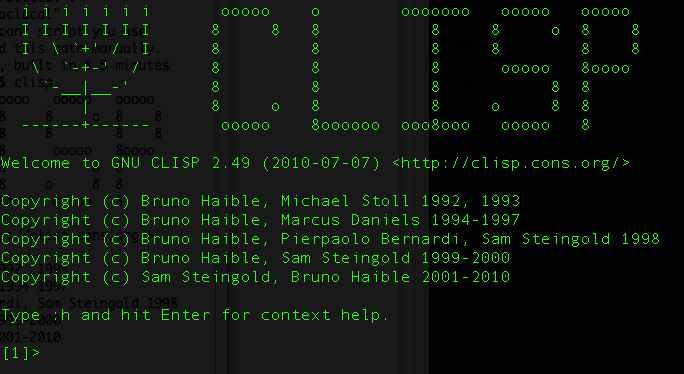
I recently purchased a book on Lisp programming that looks quite good.  Getting CLISP installed on Mac OSX 10.6, however, was not easy--until I found Homebrew.

At first I had used MacPorts, but that was a bit painful.  After a few hours I finally gave up and figured I'd just limit my LISP programming to Ubuntu. 

Lately I have been writing a LOT of Python code.  Because of that, my "temporary" absence from using XCode and iOS dev has become ... well ... prolonged.  I simply can accomplish so much more in Python, and in one-tenth the time.

I dove in to Mac development with a positive attitude, despite using Ubuntu Linux for 99% of my computer work the last several years.  Sure, it's nice to have GarageBand and the hardware on a Mac that works so well with media projects.  But ... I miss Geany.  I miss the package manager in Ubuntu.  Most of all, though, I miss the feeling of using free and open-source software, and the fact that you are NEVER harassed by the software you use.

I left Windows long ago and have never looked back.  When I first came (back) to a Mac recently, I was happy to see how similar OSX was to Linux (or BSD).  Now, however, the differences are starting to accumulate. 


Anyway, at least Homebrew got me CLISP....

Monday, April 18, 2011

A Place for Our Stuff....

Remember George Carlin's great "a place for my stuff" act?  Well, I kind of feel that way now, as I consider letting my Dreamhost account (www.futureskyline.com) expire and take advantage of alternatives for posting my stuff. 

In particular, I'm looking into options for storing a bunch of Creative Commons stuff that my students and I would like to share with the world.  Things like incidental music for video games (both MIDI and audio files), images and sprites, and also a crapload of screencasts and instructional videos.

Wednesday, March 30, 2011

Getting better....


As you can see, the dungeon floor plan generator is getting better.  In fact, it's starting to look more and more like the dungeon floorplans I used to draw up on graph paper when I should have been paying more attention in high school.  :-)

Well, it's now Spring Break (already to the midpoint, actually), so I've had a little extra time to play around with some comp sci topics that I haven't really used much in the past.  Of course I've been having fun with genetic algorithms, but those were easy to learn for me, having a degree in biology.  Not as easy are artificial neural networks.  Haven't much experience with them, so this is new ground for me.  There are many situations, though, that I suspect lend themselves to neural networks more than, say, genetic algorithms.  Regardless, it will be fun to compare and contrast....

Sunday, March 20, 2011

Getting there....


Debugging this has been the usual nightmare: any time you nest loops for these, no matter how many times you've done this, you still get mixed up between rows, colums, i, j, x, and y.  Anyway, I just need to clean up the code a bit and make a few adjustments before I can start turning these into environments to explore using the keyboard....

Saturday, March 19, 2011

A-mazing we will go.


Have been goofing around a lot lately with recursion, cellular automata, and Pygame.  Working with students to develop a floor-plan generator for dungeons and mazes has led to some fun programs.  The image above is from a Python program that creates a depth-first search maze, and then attempts to solve it using a slightly different algorithm.  The beginning square is the far upper left, and the ending is the far lower right.  White corridors have never been visited.  The pink ones were visited but led to dead ends.  The green path, however, is the correct solution.

Currently working on a version that goes beyond mazes to dungeon-like floor plans.  The program will print out the data to a text file to be used by other programs and other languages.

Wednesday, March 16, 2011

Is there something in-between?


Lately we have been goofing around a LOT with Cellular Automata and Agent-Based simulations.  Of course we're working on the Genetic Algorithms cases study, but some students have asked about other applications of these really interesting parts of computational science.

So today I was reading Cities and Complexity and came to the part where they shift from strict rule-based, deterministic cellular automata simulations, to simulations that include random elements.  I immediately remembered something that I had thought of a while back while working on some of Wolfram's one-dimensional CA studies (and then, for some reason, I completely forgot about it again until this morning).  Here's the thought:

When we think of a typical CA simulation, we use a single set of rules, like, say, Rule 110 for the one-dimensional CA that Wolfram had studied.  That rule is a strict one-to-one mapping of situation to response, so there is NO randomness at all. 

Naturally, one gets curious about what adding random elements would do to the patterns.  But then I thought of something else, and it really got me to thinking about determinism and randomness.  Let me just show you what I was thinking:

Rule 30 from Wolfram is the base 10 name for this binary mapping:

0 0 0 1 1 1 1 0

Now of course that tells each cell what to do (whether to be "on" or "off" in the next phase) for each of the eight possible situations it could be in. 

So, if we wanted to, we could randomize it by replacing one of those digits with a coin flip (f):

0 0 f 1 1 1 1 0

Here, in the third digit from the left, we have switched from "always turn off" to "turn off with a 50% chance. "  By that we mean something like, "flip a coin, dude, and heads you are on, tails you are off."

But then I remembered something I had toyed around with when thinking up some AI patterns and state machine stuff for a simple game I was working on.  What if, instead of something like "choose 1 80% of the time, chose 0 the other 20%" was handled differently?  What if we instead put an array of numbers into that particular position, with a string of results in it:

0 0 [ 1 1 1 1 0 ] 1 1 1 1 0

Now, instead of an 80% CHANCE of choosing 1, we simply tell the agent that she should respond with the number in the array--and she should increment by one each successive turn.  Meaning, using the example above, when the 3rd position in the array first comes up, she chooses 1.  She does that the 2nd, 3rd, and 4th time, also.  However, the fifth time she chooses 0.  After that she simply loops around and starts over at the beginning.  So you can see that she will choose 1 exactly 80% of the time, but there's no chance involved.  It's completely deterministic, and yet it takes the whole question of one-dimensional CA to a whole new level of, well, complexity.  Or does it?  I really haven't had much time to think about this in detail, but it seems strangely different than randomness. 

I guess what it really makes me think about is how attractive the finite set of 256 rules that Wolfram studied seemed to me at first.  How ... cozy it seemed that the structure was so, well, structured.  Now I'm thinking that there's an infinity of rules--all strictly deterministic--that could be looked at for good ol' one-dimensional CA. 

Time to hit the books....